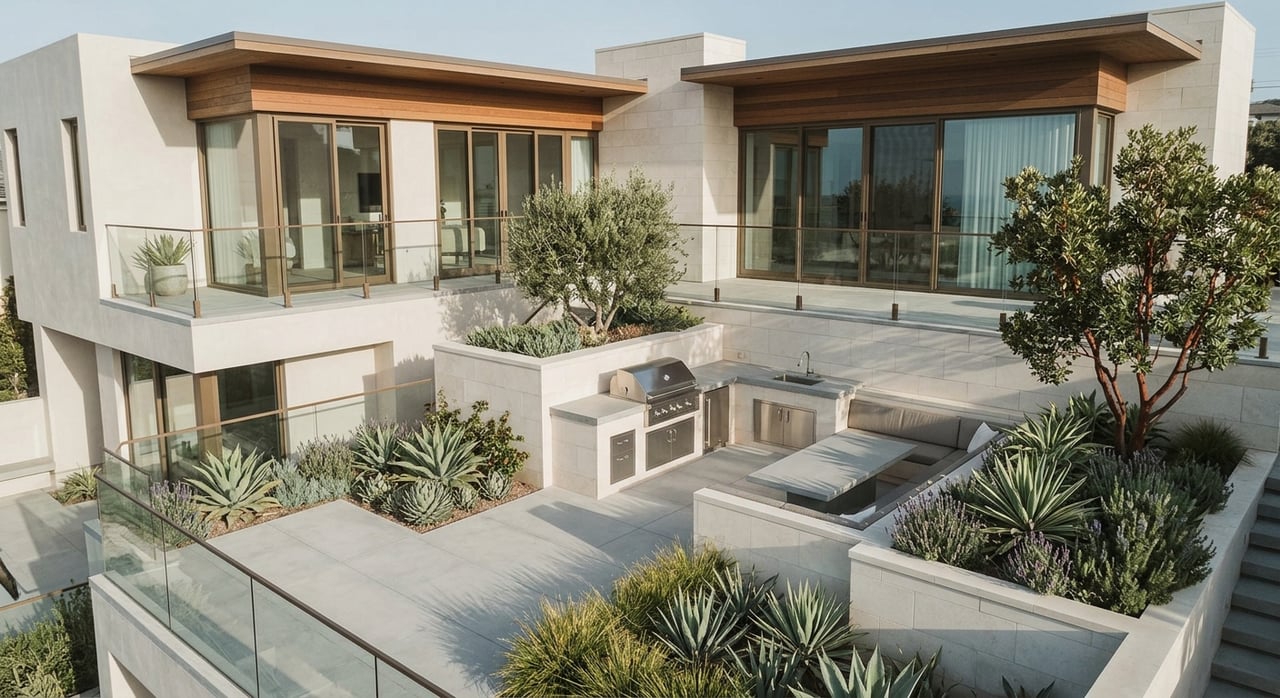
If you are weighing a custom home against a production-style luxury home in Newport Coast, you are not choosing between “nice” and “nicer.” You are choosing between two very different ownership experiences in one of Coastal Orange County’s most carefully planned markets. In a place shaped by hillside topography, protected open space, and tightly managed design rules, that choice deserves a closer look. Let’s dive in.
Why Newport Coast Feels Different
Newport Coast is part of Newport Beach, and the city notes that it was annexed in 2002. The community is known for newer homes on the hillsides, upscale hotels, the Pelican Hill Golf Course, and the preserved coastline of Crystal Cove State Park. That mix gives the area a very distinct identity.
It also helps explain why home design works differently here than in many other luxury markets. Newport Coast was planned as a 9,493-acre coastal community, with 7,343 acres dedicated to open space and recreation and a maximum of 2,600 dwelling units. The local coastal plan emphasizes clustered development to preserve open space, reduce grading impacts, and improve compatibility with public open space.
That means Newport Coast is not a blank canvas. Whether you are considering a one-of-a-kind estate or a builder-driven luxury residence, the land, views, and planning framework all shape what is possible.
What Custom Means in Newport Coast
In Newport Coast, a custom home usually means a property designed around its specific lot rather than a repeatable plan. Buyers often pursue custom homes for stronger view orientation, more privacy, and architecture that responds directly to the site. In the most estate-oriented planning areas, the local coastal program references minimum average lot sizes of 30,000 square feet, a cap of 75 single-family homes, and defined building envelopes for height and setback control.
That planning detail matters. It shows that custom living here is deeply tied to the parcel itself, not just the finishes inside the home. A well-positioned homesite can influence everything from light and privacy to how living spaces connect to coastal views.
Custom does not always mean fully unconstrained, though. Newport Beach manages building construction through its Community Development Department, and Newport Coast properties still work within coastal planning rules, setbacks, CC&Rs, and view-protection standards. So while custom homes offer greater flexibility, they still exist within a structured framework.
Crystal Cove and the Custom Spectrum
Crystal Cove is a useful example because it sits on a broad custom-to-semi-custom spectrum. TRG Land describes Crystal Cove as 772 custom and semi-custom home sites across 864 acres, with trail connections to Crystal Cove State Beach and surrounding open space. For many buyers, that setting delivers a custom feel while still reflecting the structure of a larger master plan.
This is an important distinction if you are comparing options. A home can feel highly individual while still being part of a coordinated community vision. In Newport Coast, that balance is common.
Pelican Hill Design Influence
The Pelican Hill area brings another layer to the custom conversation. The Resort at Pelican Hill describes its architecture as inspired by Andrea Palladio and a Northern Italian landscape, with a Mediterranean and Italian coastal character. In nearby residential settings, that architectural language often influences the look and feel buyers expect.
For you, that means a custom home in the Pelican Hill area may still reflect a recognizable design palette. You can often find more individuality than in a production neighborhood, but the broader setting still encourages architectural harmony.
What Production Homes Mean Here
In Newport Coast, production does not mean basic. It usually means luxury homes delivered through a master-planned neighborhood with curated streetscapes, shared design rules, and a defined group of floor plans or elevations. In many cases, you are choosing among polished luxury collections rather than comparing luxury with non-luxury housing.
This is one of the biggest misconceptions about the area. Because Newport Coast was planned around coordinated design and preserved views, many neighborhoods were built to feel cohesive from lot to lot. That consistency is part of the appeal for many buyers.
Brookfield Residential describes a process that includes selecting a floor plan and homesite, reviewing quick move-in options, and personalizing finishes through a guided interior design process. That gives you room to tailor a home, but within a more standardized and streamlined path than a fully custom build.
The Appeal of a Curated Path
For some buyers, this model is a major advantage. You can often reduce decision fatigue, shorten the road to move-in, and avoid the complexity that comes with making hundreds of site-specific design choices. The result is a more predictable ownership path.
That predictability matters in a market like Newport Coast. With hillside parcels, view considerations, and coastal rules all in play, a well-executed production-style luxury home can offer real convenience without giving up quality or prestige.
Custom vs. Production: The Core Tradeoffs
The right choice usually comes down to how you want to live, how much control you want, and how much complexity you are willing to manage. In Newport Coast, both paths can deliver exceptional results. They just do so in different ways.
Architecture and Site Positioning
Custom homes typically offer the strongest advantage if you care most about a singular design, view corridors, privacy, and a layout shaped to the lot. Since Newport Coast planning is heavily influenced by open space, grading, and building envelopes, a site-driven design can create a very different living experience from one parcel to the next.
Production homes tend to appeal when you value a polished neighborhood presentation and more predictable siting. Streets often feel more visually cohesive, and the relationship between homes is usually more structured. For some buyers, that consistency is not a compromise. It is a feature.
Design Flexibility
Custom homes usually provide broader design freedom. You may have more influence over room flow, materials, view orientation, and how indoor and outdoor spaces connect. That said, the freedom is not unlimited because Newport Coast homes still must comply with city oversight and community rules.
Production homes offer less flexibility, but the process is simpler. Instead of starting from scratch, you are often refining a proven plan. If you want a polished result with fewer moving parts, this path can be very appealing.
Ownership Experience
This is where the decision becomes personal. A custom home often requires more coordination, more patience, and more comfort with complexity. The payoff can be a home that feels deeply tailored to your lifestyle and lot.
A production-style luxury home usually makes ownership easier from the start. You may face fewer major decisions, a more guided process, and a smoother route to occupancy. For buyers who value efficiency and ease, that can matter just as much as architectural originality.
Resale Looks Different in Newport Coast
Resale in Newport Coast is often driven by lot quality, views, architecture, and overall presentation. That is especially true because this is a thinly traded luxury market where individual properties can differ meaningfully from one another.
Current data supports that point. Redfin reports Newport Coast’s median sale price at about $5.9 million over the last three months, with homes averaging 83 days on market. Realtor.com’s listing-based snapshot places the median listing price around $12 million, with homes selling about 4.8% below asking on average in May 2026 and a 95% sale-to-list ratio.
Those numbers should be read carefully. In Newport Coast, listing medians and sale medians can tell different stories because inventory is limited and the mix of homes changes. Looking at one number alone can create the wrong impression.
What Submarket Data Suggests
Neighborhood-level figures show how nuanced the market can be. Realtor.com reports Crystal Cove with a median listing price around $22 million and about 16 homes for sale, while Pelican Hill sits around a $16.995 million median listing with 22 properties for sale. In a market this selective, pricing, lot quality, and design pedigree all carry weight.
For resale, a standout custom estate can command a premium when the homesite and architecture are exceptional. At the same time, a highly specific design may appeal to a narrower buyer pool. A polished production-style home in a sought-after neighborhood may attract buyers who value turnkey ease and community consistency.
Lifestyle May Be the Deciding Factor
For many buyers, the better choice is the one that fits daily life. Custom-estate buyers often prioritize privacy, individuality, and a home that feels unlike anything else. Production-home buyers often value convenience, consistency, and shared community features.
Newport Coast supports both lifestyles well. Crystal Cove State Park offers trails, beach access, and a historic coastal district with restored 1930s-era cottages available to rent year-round. The Pelican Hill setting adds golf and a resort environment, while nearby shopping and dining areas such as Fashion Island and Crystal Cove Shopping Center contribute to everyday ease.
If your goal is a legacy property with a more distinctive architectural identity, custom may be the stronger fit. If your goal is refined coastal living with a more guided and predictable ownership path, a production-style luxury home may suit you better.
How to Think About Your Decision
The smartest way to approach Newport Coast is not to ask which option is better in general. The better question is which option better matches your priorities. In this market, greater originality and site control often sit on one side, while convenience and neighborhood consistency sit on the other.
That is why the right advice matters. A buyer who wants privacy, view alignment, and architectural individuality should evaluate lot quality and planning constraints very differently from a buyer focused on turnkey ease and curated neighborhood appeal. The surface-level look of two luxury homes may be similar, but the ownership experience can be very different.
If you are considering a move in Newport Coast, working through those tradeoffs before you buy can save time and sharpen your decision. For private guidance on custom estates, curated neighborhoods, and the nuances of Coastal Orange County luxury real estate, schedule a confidential consultation with Chris Sirianni.
FAQs
What is the difference between custom and production homes in Newport Coast?
- Custom homes are typically designed around the specific lot with more site-driven individuality, while production homes usually follow curated floor plans, elevations, and neighborhood design standards within a master-planned setting.
Are production homes in Newport Coast still considered luxury properties?
- Yes. In Newport Coast, production-style homes are often luxury residences within carefully planned neighborhoods that emphasize architectural continuity, quality finishes, and a cohesive streetscape.
Do custom homes in Newport Coast have fewer rules?
- No. Custom homes may offer more design flexibility, but they still must comply with Newport Beach oversight, coastal planning rules, setbacks, CC&Rs, and view-related standards.
Which Newport Coast home type is better for resale?
- Resale depends more on lot quality, views, architecture, pricing, and presentation than on the label alone. A standout custom estate can command a premium, while a well-located production-style home may appeal to buyers seeking turnkey convenience.
How should buyers compare Newport Coast neighborhoods like Crystal Cove and Pelican Hill?
- Buyers should compare each area based on homesite character, architectural style, privacy, community design, and how well the ownership experience matches their lifestyle goals.